
Transformations
Translation, reflection, rotation and enlargement

A transformation moves or changes a shape. There are four you need to know.
The four transformations
- Translation: slide. Described by a vector, e.g. (3, −2) means 3 right and 2 down.
- Reflection: flip in a mirror line, e.g. the line x = 2 or y = x.
- Rotation: turn. Give the angle, the direction (clockwise or anticlockwise) and the centre.
- Enlargement: resize. Give the scale factor and the centre. Scale factor 2 doubles every length.
Translations, reflections and rotations keep the shape the same size (the shapes are congruent). Enlargements make similar shapes.
Worked examples
Example 1. Translate the point (2, 5) by the vector (4, −3).
Example 2. Reflect the point (3, 1) in the y-axis.
Example 3. A rectangle 3 cm by 2 cm is enlarged by scale factor 3. What are its new sides?
Top tips and common mistakes
- Use tracing paper for rotations.
- Reflect in the x-axis: (x, y) → (x, −y). In the y-axis: (x, y) → (−x, y).
- A rotation of 90° clockwise about the origin: (x, y) → (y, −x).

Kaleidoscopes use reflections. That is why the patterns look so amazing!
Practise
Answer as many as you like. Every question is new, and you get a “correct” tick for each one you get right first time. Use “Show answer” to see a worked solution.
Quiz: earn your stamp
Printable worksheet
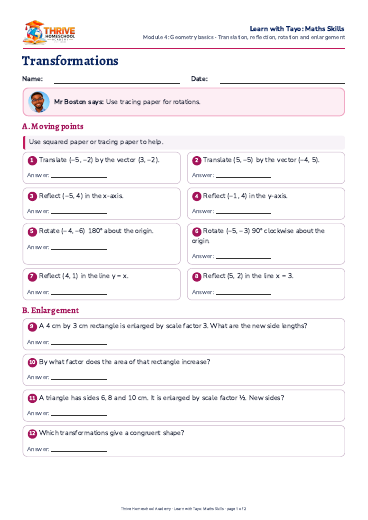
Transformations worksheet. The questions come first and the answers for grown-ups are on the last page, so you can print just the question pages.
Printing is optional. A4 size.