
Time, timetables and calendars
12- and 24-hour clocks, durations and timetables

Being good with time helps you catch buses, plan revision and never miss the start of a film.
Telling and working out time
- 24-hour clock: 3:45 pm = 15:45; 12:10 am = 00:10.
- 1 hour = 60 minutes, 1 minute = 60 seconds, 1 day = 24 hours, 1 week = 7 days, 1 year = 365 days (366 in a leap year).
- To find a duration, count on in steps: to the next hour, then whole hours, then the rest.
- Careful: time is not decimal! 1.5 hours = 1 hour 30 minutes, not 1 hour 50.
Worked examples
Example 1. A film starts at 18:45 and lasts 1 hour 50 minutes. When does it finish?
Example 2. How long is it from 09:40 to 13:15?
Example 3. Convert 2.25 hours to hours and minutes.
Top tips and common mistakes
- Never use column subtraction directly on times like 13:15 − 09:40; count on instead.
- On timetables, read along the row for a stop and down the column for one journey.
- Months with 30 days: September, April, June and November.

Counting on in chunks is my favourite way to work out how long a journey takes.
Practise
Answer as many as you like. Every question is new, and you get a “correct” tick for each one you get right first time. Use “Show answer” to see a worked solution.
Quiz: earn your stamp
Printable worksheet
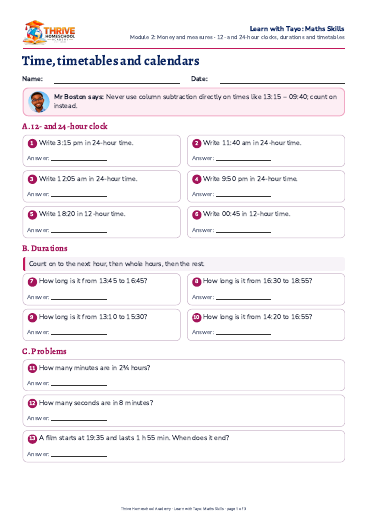
Time, timetables and calendars worksheet. The questions come first and the answers for grown-ups are on the last page, so you can print just the question pages.
Printing is optional. A4 size.