
2D and 3D shapes
Properties of shapes, symmetry, nets and plans

Shapes are everywhere. Knowing their properties helps with everything from wrapping presents to designing a room.
Shape properties
- Triangles: equilateral (3 equal sides), isosceles (2 equal sides), scalene (no equal sides), right-angled.
- Quadrilaterals: square, rectangle, rhombus, parallelogram, trapezium, kite.
- Polygons: pentagon (5), hexagon (6), heptagon (7), octagon (8), decagon (10).
- 3D shapes have faces, edges and vertices (corners). A cube has 6 faces, 12 edges and 8 vertices.
- A net is a flat shape that folds into a 3D shape.
Worked examples
Example 1. How many lines of symmetry does a regular hexagon have?
Example 2. How many faces, edges and vertices does a triangular prism have?
Example 3. Which quadrilateral has exactly one pair of parallel sides?
Top tips and common mistakes
- Euler’s rule: faces + vertices − edges = 2 for these solids. Cube: 6 + 8 − 12 = 2.
- A square is a special rectangle and also a special rhombus.
- Plans and elevations are views from above, the front and the side.

Bees build hexagons because they fit together with no gaps. Clever bees!
Practise
Answer as many as you like. Every question is new, and you get a “correct” tick for each one you get right first time. Use “Show answer” to see a worked solution.
Quiz: earn your stamp
Printable worksheet
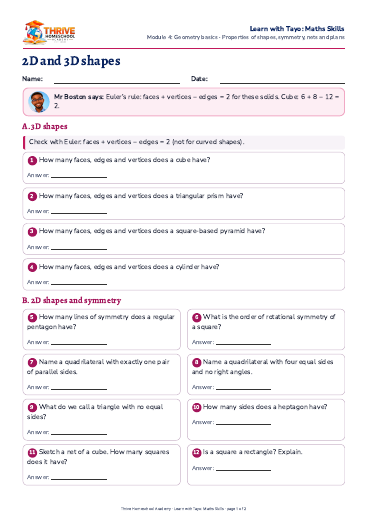
2D and 3D shapes worksheet. The questions come first and the answers for grown-ups are on the last page, so you can print just the question pages.
Printing is optional. A4 size.