
Sequences
Term-to-term rules and the nth term

A sequence is a list of numbers that follows a rule. Spotting the rule is like being a maths detective.
Two kinds of rule
- Term-to-term rule: how to get from one term to the next. 3, 7, 11, 15 … → add 4.
- Position-to-term rule (nth term): lets you find any term straight away.
For a sequence that goes up by the same amount each time (an arithmetic sequence): nth term = difference × n + (first term − difference).
3, 7, 11, 15 … difference 4, first term 3 → nth term = 4n − 1.
Worked examples
Example 1. Find the next two terms of 5, 9, 13, 17 …
Example 2. Find the nth term of 2, 8, 14, 20 …
Example 3. The nth term is 3n + 2. Find the 10th term.
Example 4. Is 50 in the sequence with nth term 4n + 3?
Top tips and common mistakes
- Some sequences are not arithmetic: square numbers 1, 4, 9, 16 … and Fibonacci 1, 1, 2, 3, 5, 8 … (add the two before).
- Check your nth term by putting n = 1, 2 and 3 into it.
- A decreasing sequence has a negative difference: 20, 17, 14 … → −3n + 23.

Patterns are everywhere: tiles, stairs and even pine cones!
Practise
Answer as many as you like. Every question is new, and you get a “correct” tick for each one you get right first time. Use “Show answer” to see a worked solution.
Quiz: earn your stamp
Printable worksheet
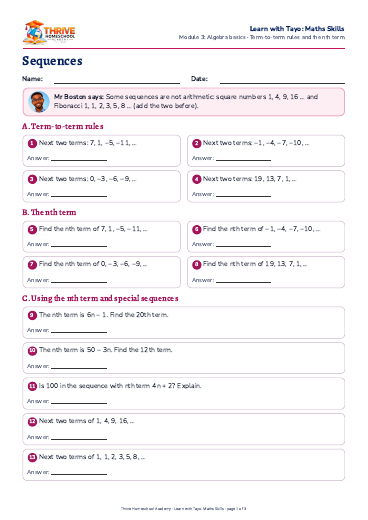
Sequences worksheet. The questions come first and the answers for grown-ups are on the last page, so you can print just the question pages.
Printing is optional. A4 size.