
Rounding and estimation
Decimal places, significant figures and quick estimates

Rounding makes numbers simpler, and estimating lets you check that a calculator answer makes sense.
How to round
- Find the digit in the place you are rounding to.
- Look at the next digit to the right.
- If it is 5 or more, round up; if it is 4 or less, keep the digit the same.
- 3,846 to the nearest hundred = 3,800.
- 7.268 to 1 decimal place (1 d.p.) = 7.3.
- 0.04362 to 2 significant figures (2 s.f.) = 0.044 (start counting at the first non-zero digit).
Estimating: round each number to 1 significant figure, then calculate.
Worked examples
Example 1. Round 52,749 to the nearest thousand.
Example 2. Round 3.14159 to 2 decimal places.
Example 3. Estimate 48.7 × 21.3.
Top tips and common mistakes
- Keep the place-holder zeros: 3,846 to the nearest hundred is 3,800, not 38.
- Estimates use “≈”, which means “approximately equal to”.
- Rounding money: give answers to 2 d.p., like £4.70, not £4.7.

Before I press = on a calculator, I make a quick estimate. It has saved me lots of silly mistakes!
Practise
Answer as many as you like. Every question is new, and you get a “correct” tick for each one you get right first time. Use “Show answer” to see a worked solution.
Quiz: earn your stamp
Printable worksheet
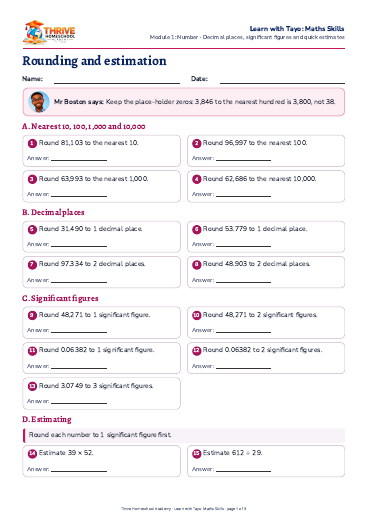
Rounding and estimation worksheet. The questions come first and the answers for grown-ups are on the last page, so you can print just the question pages.
Printing is optional. A4 size.