
Real-life problems
Budgets, bills, journeys, DIY and planning, in several steps

Real-life problems use several skills at once, just like the Essential Skills tasks. Let’s plan a family day out and decorate a bedroom!
A plan for multi-step problems
- List what you know and what you need to find.
- Break the problem into small steps.
- Do each calculation and label it (“cost of tickets”, “total area”).
- Round sensibly: you cannot buy 2.3 tins of paint, so buy 3.
- Answer the question in a sentence with units.
Worked examples
Example 1. A family of 2 adults and 3 children visits a farm park. Adults £12.50, children £8.75. They have a voucher for 10% off. What do they pay?
Example 2. A wall is 4 m wide and 2.5 m high. One tin of paint covers 6 m². Two coats are needed. How many tins?
Example 3. A car uses 6 litres of fuel per 100 km. Fuel costs £1.45 per litre. What does a 250 km trip cost?
Top tips and common mistakes
- Round up when you need “enough” (tins, buses, boxes); round down when you can only make complete items.
- Write money to 2 decimal places.
- Check the answer is realistic: a day out costing £4,613 would be wrong!

We used this exact method to plan our holiday budget. Maths really is for real life!
Practise
Answer as many as you like. Every question is new, and you get a “correct” tick for each one you get right first time. Use “Show answer” to see a worked solution.
Quiz: earn your stamp
Printable worksheet
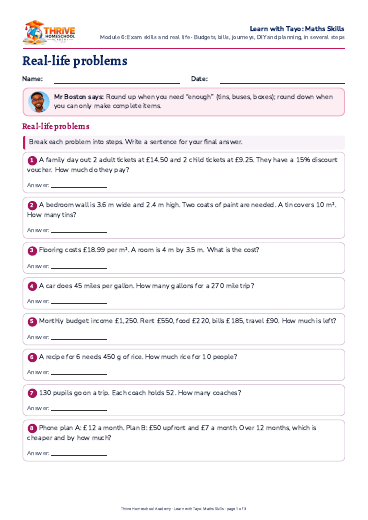
Real-life problems worksheet. The questions come first and the answers for grown-ups are on the last page, so you can print just the question pages.
Printing is optional. A4 size.