
Pythagoras’ theorem
Finding sides in right-angled triangles

Pythagoras’ theorem is over 2,500 years old and builders still use it every day to make perfect right angles.
The theorem
In a right-angled triangle, the longest side (opposite the right angle) is the hypotenuse, c.
a² + b² = c²
- To find the hypotenuse: square the two short sides, add, then square root.
- To find a short side: square the two sides, subtract, then square root.
Famous whole-number triples: 3, 4, 5 · 5, 12, 13 · 8, 15, 17 · 6, 8, 10.
Worked examples
Example 1. The short sides are 6 cm and 8 cm. Find the hypotenuse.
Example 2. The hypotenuse is 13 cm and one side is 5 cm. Find the other side.
Example 3. A 5 m ladder leans against a wall with its foot 2 m from the wall. How high does it reach (1 d.p.)?
Top tips and common mistakes
- The hypotenuse is always the longest side, so check your answer is (or isn’t) the biggest.
- Only use Pythagoras in right-angled triangles.
- Find the distance between two points by drawing a right-angled triangle between them.

Builders use a 3, 4, 5 triangle made of rope to check corners are square. Ancient maths, still working!
Practise
Answer as many as you like. Every question is new, and you get a “correct” tick for each one you get right first time. Use “Show answer” to see a worked solution.
Quiz: earn your stamp
Printable worksheet
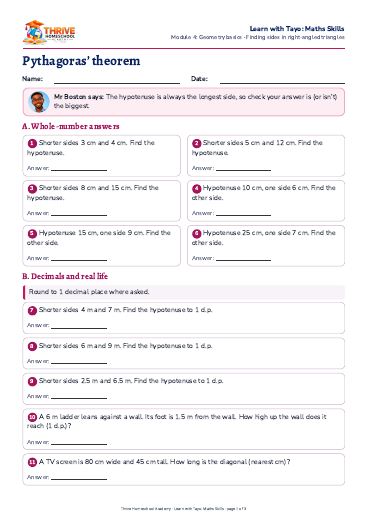
Pythagoras’ theorem worksheet. The questions come first and the answers for grown-ups are on the last page, so you can print just the question pages.
Printing is optional. A4 size.