
Module 1: Number · Topic 6 of 26
Powers and roots
Squares, cubes, square roots and index notation
VIDEO LESSON Watch Mr Boston explain powers and roots

Mr Boston
A power is a short way of writing repeated multiplication. 5 × 5 × 5 is written 5³ (“5 cubed”).
Squares, cubes and roots
- Square numbers: 1, 4, 9, 16, 25, 36, 49, 64, 81, 100, 121, 144 … (n² = n × n)
- Cube numbers: 1, 8, 27, 64, 125, 1,000 … (n³ = n × n × n)
- Square root √ undoes squaring: √49 = 7. Cube root ∛ undoes cubing: ∛64 = 4.
- Index laws (GCSE): 2³ × 2⁴ = 2⁷ (add the powers); 5⁶ ÷ 5² = 5⁴ (subtract the powers).
Worked examples
Example 1. Work out 4³.
4 × 4 × 4 = 16 × 4 = 64.
Example 2. Work out √81 + 2².
√81 = 9 and 2² = 4, so 9 + 4 = 13.
Example 3. Write 3⁵ × 3² as a single power of 3.
Add the powers: 3⁷.
Top tips and common mistakes
- 3² is 9, not 6! Squaring means multiplying by itself, not by 2.
- Learn the squares up to 15² = 225 and cubes 1, 8, 27, 64, 125 and 1,000.
- Any number to the power 1 is itself; any number (except 0) to the power 0 is 1.

Tayo
Square numbers make square patterns of dots. 16 dots make a 4 by 4 square!
Practise
Answer as many as you like. Every question is new, and you get a “correct” tick for each one you get right first time. Use “Show answer” to see a worked solution.
Quiz: earn your stamp
Printable worksheet
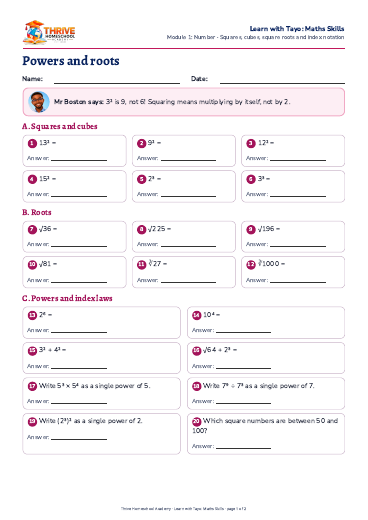
Powers and roots worksheet. The questions come first and the answers for grown-ups are on the last page, so you can print just the question pages.
Printing is optional. A4 size.